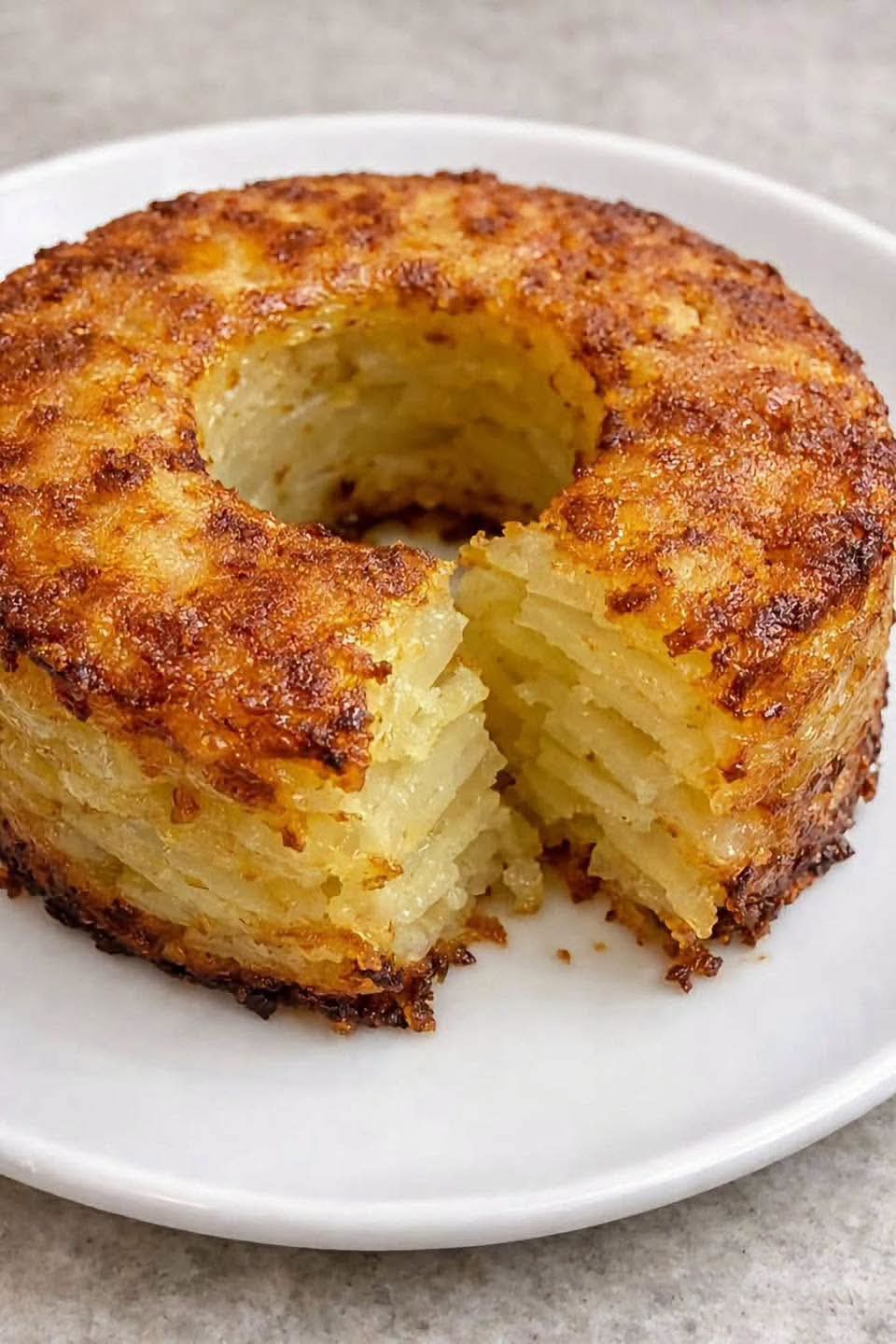
Oven Baked 3-Ingredient Potato Ring: A Crispy, Golden Showstopper transforms potatoes, butter, and Parmesan cheese into an impressive side dish with crisp, deeply golden edges and a tender, layered center.
Thin potato slices are arranged in a ring and baked until they hold together beautifully when inverted onto a platter. Despite its elegant presentation, preparation is straightforward and uses familiar, affordable ingredients. Serve this crispy potato ring with a holiday roast, Sunday dinner, grilled meat, or a fresh salad for a memorable alternative to ordinary roasted potatoes.
Why You’ll Love This Recipe
Only three ingredients: Potatoes, butter, and Parmesan create a flavorful side without a long shopping list.
Crispy outside and tender inside: The exposed surfaces become golden while the tightly packed layers remain soft.
Impressive presentation: The ring shape looks attractive on a holiday or dinner-party table.
Easy preparation: Most of the work involves slicing and arranging the potatoes.
Versatile side dish: It pairs well with chicken, beef, pork, seafood, and vegetable-based meals.
Budget-friendly: The estimated cost is approximately $0.60–$1 per serving, depending on local prices and the type of Parmesan used.
The Three Essential Ingredients
Potatoes
Use 4–5 medium potatoes, or approximately 2 pounds total. Russet potatoes produce light, tender layers with crisp edges because of their higher starch content. Yukon Gold potatoes create a slightly denser ring with a naturally buttery flavor.
Choose potatoes of a similar size so the slices fit together evenly. Peel them before slicing for the smooth, uniform appearance shown in the finished dish.
Butter
A half cup of melted butter coats the slices, promotes browning, and prevents the layers from drying out. Salted butter provides additional seasoning without requiring a fourth ingredient. Unsalted butter also works, although the finished potato ring will taste more mildly seasoned.
Parmesan Cheese
Finely grated Parmesan melts between the potato layers and forms a savory golden crust. Freshly grated cheese generally melts more evenly than thick pre-shredded pieces. Finely grated refrigerated Parmesan is also a practical option.
Recommended Kitchen Equipment
A 10-inch Bundt pan or tube pan creates the distinctive ring shape. Choose a sturdy pan with a relatively simple interior rather than one with many deep decorative grooves, which can make the potatoes difficult to release.
A mandoline slicer is the easiest way to cut consistently thin, ⅛-inch slices. Always use its hand guard. A sharp chef’s knife can also be used, but try to keep every slice approximately the same thickness.
You will also need a large mixing bowl, a pastry brush or spoon for greasing the pan, aluminum foil, and a serving platter wider than the pan.
How to Make Oven Baked 3-Ingredient Potato Ring: A Crispy, Golden Showstopper
1. Prepare the Oven and Pan
Preheat the oven to 400°F (200°C). Generously brush the bottom, sides, and center tube of a 10-inch Bundt or tube pan with some of the melted butter.
Thorough greasing is important because Parmesan can form a firm crust that sticks to an ungreased surface.
2. Slice the Potatoes
Peel the potatoes and cut them into slices approximately ⅛ inch thick. Uniform slices cook at the same rate and create neat, compact layers.
Do not rinse or soak the slices after cutting them. The natural surface starch helps the layers adhere to one another.
3. Coat the Potato Slices
Place the sliced potatoes in a large bowl. Add the remaining melted butter and grated Parmesan, then gently toss until the slices are evenly coated.
Separate any slices that have stuck together so the butter and cheese can reach as much of their surface as possible.
4. Fill the Pan
Arrange the coated potato slices around the prepared pan, overlapping them and pressing them together firmly. Distribute the Parmesan remaining in the bowl between the layers.
Keep the height reasonably even around the entire ring. Compacting the potatoes helps the finished dish hold its shape after it is inverted.
5. Cover and Bake
Cover the pan tightly with aluminum foil and bake for approximately 45 minutes. The foil traps steam, allowing the center of the thick potato layers to soften before the outside becomes too dark.
Carefully remove the foil and continue baking for 25–35 minutes. The potato ring is ready when the exposed surface is deeply golden and a thin knife slides easily through the center of the layers.
If the potatoes are tender but not sufficiently browned, bake uncovered for another 5–10 minutes while watching closely.
6. Rest and Invert
Allow the potato ring to rest in the pan for 10 minutes. This short cooling period lets the layers firm up without becoming cold.
Run a thin silicone spatula or butter knife gently around the outer edge and center tube. Place a large serving platter upside down over the pan. Holding the pan and platter securely together, turn them over in one confident motion.
Lift the pan slowly. If part of the ring resists, set it back down and loosen that area before trying again.
Professional Tips for the Best Results
Cut the potatoes no thicker than ⅛ inch. Thick slices may remain firm in the center.
Grease every part of the pan that will touch the potatoes.
Use finely grated Parmesan so it spreads evenly and helps bind the layers.
Pack the slices firmly to prevent the ring from falling apart.
Check tenderness with a thin knife instead of relying only on surface color.
Let the ring rest before inverting, but do not leave it in the pan until completely cold.
Place a sheet pan beneath the Bundt pan if it is filled close to the top, as a little butter may bubble over.
Common Mistakes and How to Avoid Them
The Potatoes Are Still Firm
The slices may have been too thick, or the ring may need more covered baking time. Cover the pan again and continue baking in 10-minute increments until a knife passes through the layers easily.
The Ring Sticks to the Pan
This usually happens when the pan was not greased thoroughly or the potato ring cooled for too long. Generously butter the pan, loosen the edges before inverting, and turn it out after approximately 10 minutes.
The Ring Falls Apart
Uneven slices or loosely packed layers can prevent the potatoes from holding together. Slice them uniformly, coat them thoroughly, and press down firmly while filling the pan.
The Exterior Browns Too Quickly
If the exposed potatoes become dark before the center is tender, replace the foil loosely and continue baking until fully cooked.
Optional Variations
Each of the following additions changes the recipe from the original three-ingredient version and should be considered optional:
Garlic and herb: Add 1 teaspoon garlic powder and 1 tablespoon chopped rosemary or thyme.
Extra cheesy: Add ½ cup shredded cheddar, Gruyère, or mozzarella between the layers.
Smoky and spicy: Add ½ teaspoon smoked paprika and a pinch of red pepper flakes.
Potato and onion: Place very thin onion slices between some of the potato layers.
Sweet potato version: Replace some or all of the regular potatoes with peeled sweet potatoes. Begin checking them slightly earlier because their texture and cooking time can vary.
What to Serve With a Potato Ring
This golden potato side is suitable for both casual dinners and special occasions. Serve it with roasted chicken, pot roast, pork tenderloin, baked ham, steak, or grilled salmon.
For a lighter contrast, add a crisp green salad, roasted asparagus, green beans, or steamed broccoli. Gravy or a creamy dipping sauce can be offered separately, but the buttery Parmesan layers are flavorful enough to serve without sauce.
The ring shape makes it especially attractive for Thanksgiving, Christmas, Easter, Sunday dinner, potlucks, and birthday meals.
Make-Ahead Instructions
For the best color and texture, assemble and bake the potato ring on the same day. Peeled raw potatoes can discolor when exposed to air, so assembling it a full day in advance is not ideal.
To save time, grate the Parmesan and melt the butter in advance. The potatoes can then be sliced, coated, and arranged shortly before baking.
Alternatively, bake the entire ring earlier in the day, refrigerate it after cooling, and reheat it uncovered before serving.
Storage and Reheating
Refrigerate leftovers in an airtight container for up to 3 days.
For the crispiest results, place individual portions on a sheet pan and reheat at 375°F (190°C) for 10–15 minutes. An air fryer can also be used at 350°F (175°C) for approximately 5–8 minutes. Microwave reheating is convenient, but it will soften the crisp exterior.
Freezing is possible, although the potatoes may become slightly softer after thawing. Wrap individual portions securely and freeze for up to 1 month. Thaw overnight in the refrigerator before reheating in the oven.
Leftovers can also be chopped and browned in a skillet for breakfast or served alongside eggs.
Frequently Asked Questions
Can I use a regular round baking pan?
Yes. Use a 9-inch round cake pan or oven-safe skillet. The potatoes will form a layered cake instead of a ring, but the flavor and texture will be similar.
Which potatoes work best?
Russets produce a softer, starchier center and crisp exterior. Yukon Gold potatoes create creamier, slightly firmer layers. Both are suitable.
Do I need to boil the potatoes first?
No. Thin slicing and covered baking allow the potatoes to cook completely in the oven.
Why shouldn’t I rinse the sliced potatoes?
Rinsing removes surface starch. For this recipe, that starch is useful because it helps the layers cling together after baking.
How do I know the center is cooked?
Insert a thin knife into the thickest section. It should slide through the potato layers with little resistance.
Can I use pre-shredded Parmesan?
Yes, but finely grated Parmesan distributes and melts more evenly. Avoid very thick cheese shreds if you want a uniform crust.
Can I prepare this without a mandoline?
Yes. Use a sharp knife and cut the potatoes as evenly as possible, aiming for slices approximately ⅛ inch thick.
Printable Recipe Card
Oven Baked 3-Ingredient Potato Ring: A Crispy, Golden Showstopper
Thinly sliced potatoes coated with melted butter and Parmesan, layered in a ring pan, and baked until tender inside and crisp and golden outside.
Prep time: 20 minutes
Cook time: 70–80 minutes
Resting time: 10 minutes
Total time: 1 hour 40 minutes–1 hour 50 minutes
Servings: 8
Ingredients
4–5 medium Russet or Yukon Gold potatoes, approximately 2 pounds, peeled
½ cup (1 stick) butter, melted
½ cup finely grated Parmesan cheese
Instructions
1. Preheat the oven to 400°F (200°C).
2. Generously grease the inside and center tube of a 10-inch Bundt or tube pan using some of the melted butter.
3. Slice the peeled potatoes evenly into ⅛-inch-thick rounds.
4. Place the slices in a large bowl. Add the remaining melted butter and Parmesan, then toss until evenly coated.
5. Arrange the slices tightly around the prepared pan, overlapping and pressing them firmly into compact layers.
6. Cover tightly with foil and bake for 45 minutes.
7. Remove the foil and bake for another 25–35 minutes, until deeply golden and completely tender when tested with a thin knife.
8. Rest in the pan for 10 minutes.
9. Loosen the outer edge and center carefully, then invert the potato ring onto a large serving platter.
10. Slice and serve warm.
Notes
Do not rinse or soak the potato slices; their surface starch helps hold the ring together.
Baking time can vary according to the potato variety, slice thickness, pan material, and depth of the layers.
Optional herbs, garlic, spices, or additional cheeses will make this a variation rather than a three-ingredient recipe.
Estimated cost: approximately $0.60–$1 per serving.
Storage
Refrigerate leftovers in an airtight container for up to 3 days. Reheat uncovered at 375°F (190°C) for 10–15 minutes.
Estimated Nutrition
Approximately 220 calories per serving, with 20g carbohydrates, 5g protein, 13g fat, and 2g fiber.